If you’re spotting small insects around your home in Pennsylvania, it’s easy to assume they’re just ants and move on. But misidentifying termites as ants can be a costly mistake. While both pests may look similar at a glance, especially during swarming season, their behavior, risk level and required treatment are very different.
Here’s how to tell them apart and what it means for your home.
Why Proper Identification Is Critical
Not all pests carry the same level of risk. Ants are typically a nuisance (with a few exceptions like Carpenter Ants that can cause structural damage as well), while termites are a structural threat that can cause significant damage before you even realize they’re present. Knowing the difference early can save you thousands in repairs.
Key Visual Differences
- Antennae
- Take a closer look at the head:
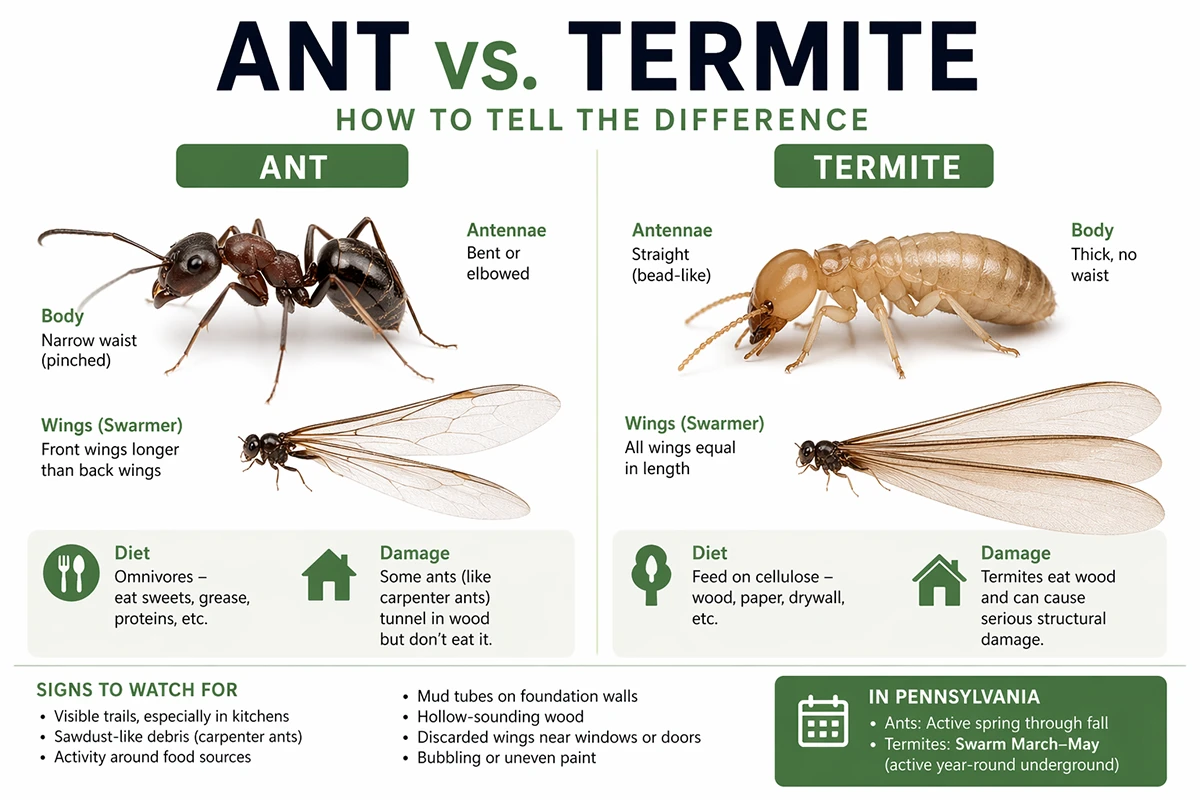
- Ants have bent or “elbowed” antennae.
- Termites have straight, bead-like antennae.
- Body Shape
- The quickest way to distinguish between ants and termites is their body structure:
- Ants have a narrow, pinched waist and clearly segmented bodies.
- Termites have a thick, uniform body with no defined waist.
What About Winged Swarmers?
Both ants and termites produce winged swarmers in the spring, which is where confusion often happens.
Termite swarmers have four wings of equal length that extend well past their body.
Ant swarmers have two sets of wings, with the front wings noticeably longer than the back.
If you’re finding discarded wings near windows, doors or light sources, that’s often your first warning sign- especially for termites.
Behavior and Diet
This is where the differences become more serious.
Termites feed on cellulose, which is found in wood, paper, and even drywall. That means they are actively eating the structure of your home.
Ants are opportunistic feeders. They’re drawn to food, grease, sugar and sometimes moisture. Carpenter Ants tunnel through wood, but they don’t eat it- they’re creating space for nesting. Keep in mind that this can cause structural wood damage, too.
Signs of an Infestation
Common Signs of Termites
- Mud tubes along your foundation or basement walls
- Wood that sounds hollow when tapped
- Bubbling or peeling paint that resembles water damage
- Piles of discarded wings near windowsills or entry points
Common Signs of Ants
- Visible trails along floors, walls or countertops
- Small piles of sawdust-like debris (from carpenter ants)
- Activity concentrated around food sources
Pest Seasonality in Pennsylvania
Understanding local pest patterns helps with early detection:
Termites– particularly Eastern Subterranean termites common in Pennsylvania- typically swarm between March and May but remain active underground year-round.
Ants are most active from spring through early fall.
The Importance of Termites vs. Ants
If you’re dealing with ants, you likely have a manageable pest issue. If you’re dealing with termites, you could be facing structural damage that worsens over time.
When in doubt, don’t guess. You’ll want to reach out to Gilbert’s Pest Control right away.
Schedule a Professional Termite Inspection
If you’re seeing signs of insect activity in Carlisle, Mechanicsburg, Camp Hill, Shippensburg and the surrounding areas and aren’t sure what you’re dealing with, a professional inspection is the safest next step. Early identification allows for targeted treatment and prevents minor issues from becoming major repairs.
Contact us today to schedule a termite inspection or pest evaluation and protect your home before the damage spreads. You can upload a picture HERE so that we can determine a course of treatment prior to the first appointment.